Table of Contents:
- Your Website is Outdated:
- Your Website is too Broad
- Your Services Aren’t Specific Enough
- There Isn’t Enough Information for People or Google to Understand Your Business
- Your Calls to Action Aren’t Giving People a Reason to Act
- Your Website Is Frustrating to Use
- You Haven’t Proven You’re the Right Company to Solve Their Problem
- A Good-Looking Website and a High-Performing Website Are Not the Same Thing
Almost every business owner I have talked with has told me the same, similar story: “My website doesn’t get me any leads” or “isn’t a website just a thing people have to look nice?” or “I have a website but isn’t it just there to show people we’re legit?”.
I get it.
Business websites have received a bad rep over the years simply because most websites are treated with the set it and forget it mind set. Oftentimes, a business pays someone a lot of money to build a site that looks great, they are thrilled for a few months, then boom, it’s just a website that really doesn’t do much.
So the business owner gets the impression that “websites just don’t drive leads and they’re a waste of money”.
I am here to tell you that couldn’t be further from the truth.
A great website will not only help you get more quality leads but it will also become a pivotal tool for your business to promote yourself online, help current customers get the right information they need, and help to establish you as an expert in your field.
My name is Josh Stenger, and I am the President and Founder of Wilder One Media. Over the years I have worked with really every type of company you can think of in industries such as:
- Landscaping
- Financial Services
- Dentistry
- Retail Fixtures & Displays
- Medical Spas
- Beauty Products
- Men’s Jewelry
- River Rafting Tours
- Real Estate
- Commercial Printers
- Electricians
- Roofing
- Law Firms
- Catamaran Boat Rentals
- Chiropractic’s
- Logistics
- Manufacturing
- Car Dealerships
- Sports Camps
- Accounting
- Etc
You get the point. I’ve been around the block with really every type of business.
The point of this blog isn’t to show you just how experienced I am or how I can solve all of your Business needs.
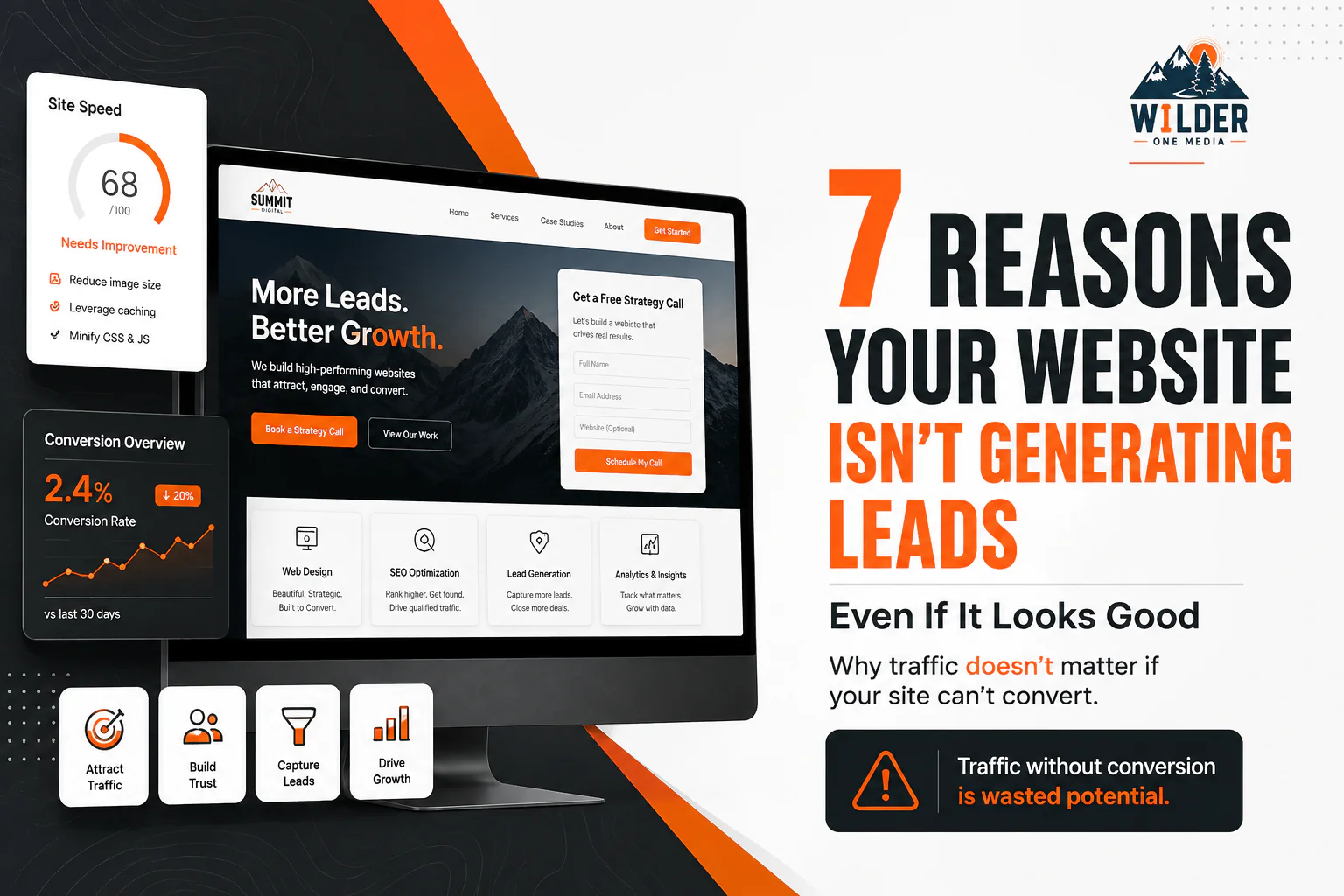
No, this blog is to show you the main 7 Reasons I have found that severely impact a business’s ability to generate quality leads through their websites.
I have found it doesn’t matter what industry you’re in or how different you are from every other business. In one way shape or form, one or more of the reasons below has significantly impacted EVERY BUSINESS I have ever worked with.
So without further ado, here are the 7 Reasons Your Website Isn’t Generating Leads:
- Website Is Outdated
- Website Is Too Broad
- Services Aren’t Specific Enough
- There Isn’t Enough Information for People or Google to Understand Your Business
- Calls to Action Aren’t Giving People a Reason to Act
- Website Is Frustrating to Use
- You Haven’t Proven You’re the Right Company to Solve Their Problem
Your Website is Outdated:
We’ve all been to a website and been like “woaaahhh” just look at that dinosaur of a webpage in front of me.
While this is a dramatic way to put it, the principal is true. If your site is outdated, chances are it is causing many problems you aren’t even aware of.
For example, outdated websites:
- Make people question if you are still in business
- Often are extremely slow
- Studies show if your site doesn’t load in 3 seconds or less people will leave.
- Aren’t consistently updated
- This includes on the back end and the front end that visitors see. By not making updates you are missing out on current industry trends, providing the necessary and relevant information, and much more.
- On the back end, not making consistent updates has severe repercussions. Your site builder (if you are using one) could become outdated which is a whole other story. Briefly an outdated builder not only leaves your site vulnerable to cyber attacks, but also leads to website crashes, broken layouts or missing elements, broken buttons, forms, links, menus etc. It will also directly impact your site speed, site cache, database errors or corrupt files and much more (story for another time).
- Don’t accurately reflect all your updated services
- Lack content which hurts your searchability
- And much more
Your Website is too Broad
This is a big one. Many businesses get caught trying to reach any and everyone they can. The problem with this is you become generic. When you get specific, yes you might limit the amount of traffic you get, but you INCREASE the amount of QUALITY traffic you get.
Broad websites also typically have over used industry jargon that the customer doesn’t understand, they ramble on about who knows what that no one is willing to read, and they just flat out don’t speak to the customer.
Broad websites also tend to combine their services/products under one category or as few categories as possible.
This can look like “landscaping services” or just “services” in general and on that page they just talk about all of their landscape services. To the normal person you might be thinking “what’s the problem with this” they still end up talking about all their services so no harm no foul right?
WRONG.
Don’t worry we will cover this below in the section “Your Services Aren’t Specific Enough”.
Your website needs to answer these questions as specifically and accurately as possible:
- Who do you help?
- What do you help them with?
- Why should they choose you?
- What are they supposed to do next?
If a site visitor can’t answer all of these questions without a problem, well then you have already lost them.
Your Services Aren’t Specific Enough
Listing your services is not the same as explaining them.
To go back to my landscaping example, a company might have one page that says it provides “Landscaping”, “Manufacturing Solutions”, “Hardscaping” and “Maintenance” but those categories can literally represent dozens of different services.
For example, under hardscaping also falls retaining walls, paver patios, driveways, walkways and paths, pools, outdoor kitchens, pergolas, gazebos, fire pits and much more.
And before you ask, yes, I have worked with a landscaping company that provides landscaping and all of those hardscape solutions too.
The point is, why would a potential customer ever reach out to you if you can’t give them enough information on how you can solve their specific need?
Each service or product should be broken down to be as simple as possible while still providing enough information to the potential customer to feel confident in purchasing from you.
The more specific the better.
Breaking down your offerings into smaller, more specific offerings not only helps your customer but it will also help boost your searchability online a significant amount which leads us to our next section…
There Isn’t Enough Information for People or Google to Understand Your Business
This is probably the single most important part of this blog. It is the reason why so many companies (like myself) offer SEO (search engine optimization) as its whole own service.
Let me paint the picture for you.
Imagine you are a highly motivated, do it yourself type of person who is considering doing an entire home remodel on their house.
Like any rational person, you understand you simply do not know enough about home remodeling to even begin at the moment.
So what do you do?
You decide “hey, if I’m going to do this thing, I should probably educate myself on everything there is to know before I waste all my money and end up in a worse situation than where I started”.
So you decide that you are going to buy a book that has everything you need to know to do a complete home remodel yourself.
You head to the local bookstore and find a massive section (far larger than you thought) that contains all sorts of different books on home remodeling.
Now you have to go through the options of books and decide which one you will purchase.
You start to think “hmm this one is just a picture book for kids, that won’t help me.”
You grab another off the shelf “this one is better, but the cover and table of contents don’t really tell me what exactly the book is about” so you put the book back.
Finally, after what felt like an eternity searching you find the perfect book. It addresses your exact situation on the back and specifically mentions it is a do it yourself how to book.
You open the book and the table of contents perfectly describes step by step what you need to do. Starting with what needs to be done first and ends with the last step.
You purchase the book as you feel this specific book addresses all of your needs and tells you literally everything you would need to know.
How great!
If you haven’t caught on yet….
You are a search engine.
And instead of finding the perfect book, you’re trying to help someone on the internet find the perfect result for their search.
In our example, the children’s book represents a site with great pictures but lacks enough content to really help us. Therefore a search engine slaps a label on your domain basically saying “I think they do this, but I’m not too sure” pushing you deep deep down in the rankings.
The second book represents a site that might be highly relative to what the internet searcher is looking for but the structure of the site makes it extremely hard to understand what it is they do.
This could be from a generic title like “We help you grow your business” which could be true but HOW are you helping me grow my business. A search engine then continues to crawl the site but keeps stumbling while trying to figure out what each page is about.
The third book represents a site that is just perfect. It is crystal clear on what they do, it has hundreds of pages that detail all their services and it has so much information that the search engine can’t help but think “put this sucker at the very top”.
Now to be more technical than you probably need me to be, I will briefly explain how a search engine boosts you in the rankings.
It will scan your site frequently and it will look for a variety of things like what keywords are on your site, do you have unique images, is the heading structure correct, are the relative highly searched keywords in headings, how much content does it have, is the content relative, what are people saying about the site, how fast does it load, does it have internal links, does it have outbound links, do other reputable sites link to this site, what is the bounce rate, is this site spammy, etc.
You get the point.
Most websites never generate quality leads, let alone leads in general because they treat their website like a nice to have instead of a need to have.
Search engines are constantly changing how they rank sites and if you aren’t actively pushing out content or optimizing your site, sorry to say it but you will fall way behind.
You will get pushed to the bottom of search results and your dream customer will never have the chance to find you.
Your Calls to Action Aren’t Giving People a Reason to Act
So now you have updated your site, made it more specific/unique, expanded your services, added more content and done SEO.
The steps above will help you dramatically increase traffic to your site. However, we don’t just want a traffic increase, we want an increase in LEADS GENERATED.
So how do we do this?
We focus on your Calls to Action.
Your Calls to Action should be specific to your offering, they should be enticing, and they should be accompanied by enough relevant information for the visitor to understand that you are the expert they need or you have the product they need.
Some great ways to generate quality leads is by:
- Offering a discount
- Running a promotion
- A free item like a:
- White paper
- Case Study
- Webinar
- Consultation
- Audit of some sort
- Really anything you can give them for free that would immediately add value to them
- Etc
Your CTA needs to offer VALUE. If the visitor doesn’t see value, they will not give you their information. You know your business best, so I would encourage you to think of what you could offer a potential customer (specific to that service) that would entice them to give you their information and want to move forward with you.
For example, on my own site I run a free site/lead leak audit. Essentially, I provide the person with a short audit of their site that talks about their rankings, keywords, position, technical issues and more.
It takes me anywhere from 30 minutes to 2 hours but it creates OPPORTUNITY.
I then create a 30 minute meeting where I walk through and explain everything that I found to them.
At that point they can either see the value I created and want me to do the work for them, or I have given them enough information to do it on their own (chances are you can’t do it on your own without sacrificing time that should be focused on your business).
But nonetheless, I still have provided them with valuable insights and information they can use even if they decide they don’t want to work with me.
I would encourage you to think how you can use this similar strategy for your business and then watch the leads start pouring in.
Your Website Is Frustrating to Use
This one is simple but very effective. Many sites today are built like an essay. The overwhelm the reader with a surplus of information that is too technical and takes too long to read.
Your site should be as simple as possible to navigate.
The visitor should clearly understand what you do, where/how you do it, and what to do next.
Sites should be fully optimized for scanning while still providing enough information if something catches their eye. It can be a difficult task to find the sweet spot but with a little effort you’ll get there.
Along these lines are a variety of other factors that make your site frustrating to use such as:
- Too many menu options
- Slow page load
- Broken links
- Difficult to read text
- Too many pop ups
- Lack of structure
- Etc
A good user experience looks like this:
“ I have a problem” ? “This company understands my problem” ? “I trust this company enough to reach out”
Every unnecessary obstacle between those stages creates another opportunity for someone to leave.
And last but certainly not least…
You Haven’t Proven You’re the Right Company to Solve Their Problem
This is one of the biggest reasons your site might not be generating leads.
If you have proved to the site visitor that you are absolutely and expert in your field, they will leave and find someone who can demonstrate their expertise.
And the chances are, once they leave your site, they will never come back.
Nearly every business says the same things about itself.
“We provide high-quality service.”
“We put our customers first.”
“We are experienced professionals.”
“We pride ourselves on exceptional results.”
Those statements sound good, but they are also incredibly easy to say.
Your customers are looking for proof.
If you want someone to trust your business, show them why they should.
That can include:
- Customer reviews
- Testimonials
- Before-and-after examples
- Case studies
- Project photography
- Measurable results
- Certifications
- Awards
- Years of experience
- Recognizable clients
- Industry expertise
- Detailed explanations of your process
Most importantly, demonstrate that you understand the customer’s problem.
When someone reads your website and thinks, “These people understand exactly what I am dealing with,” you have already separated yourself from a large percentage of your competitors.
Expertise is not something your website should simply claim.
It should be visible throughout the entire experience.
A Good-Looking Website and a High-Performing Website Are Not the Same Thing
There is nothing wrong with wanting your website to look great.
It should.
But design is only one part of what makes a website effective.
A high-performing website combines strong design with clear messaging, useful information, search visibility, credibility, user experience, and intentional calls to action.
Your website should be working for your business every day.
It should help potential customers discover you.
It should educate them.
It should build confidence.
And ultimately, it should make taking the next step feel easy.
If your website looks good but the leads are not coming in, the problem may not be your business.
It may simply be that your website is not giving your customers enough reasons to choose it.
At Wilder One Media, we build websites around more than appearance. We focus on creating digital experiences designed to help businesses get found, establish trust, and turn more of the right visitors into real opportunities.
Think your website may be leaving leads on the table? Get in touch with Wilder One Media and let’s take a closer look.